
Growing hair like Anakin Skywalker means targeting roughly 5 to 7 inches (12 to 18 cm) of length at the back, with graduated sides and a loosely layered, slightly wavy texture. Most people starting from a short cut will need 12 to 18 months of consistent growth to get there, depending on their natural rate. The good news is that the look is achievable for most hair types, and if your hair isn't quite cooperating on its own, there are styling, medical, and cosmetic options that can bridge the gap.
How to Grow Hair Like Anakin Skywalker: A 12‑Month Plan

Marcus Holloway
23 Jul 2026
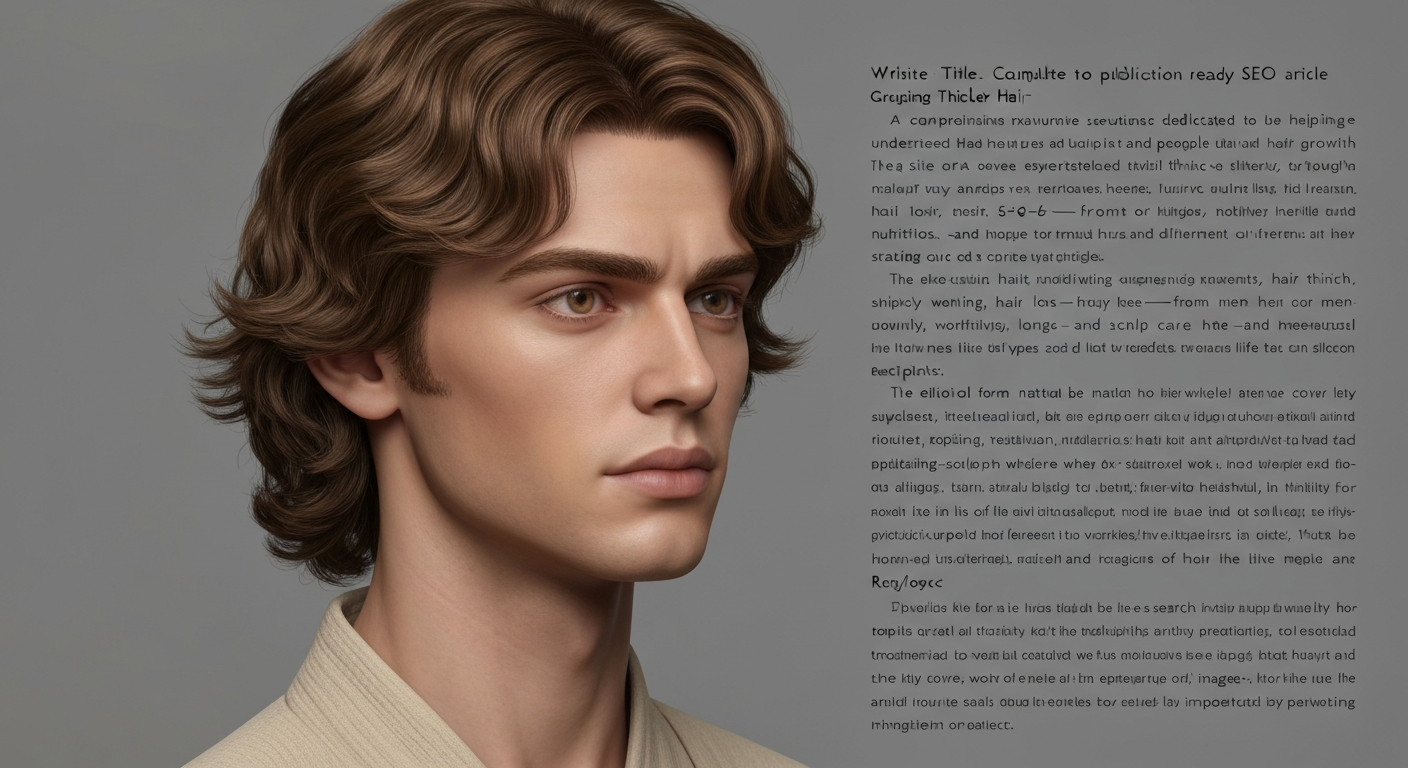
Which Anakin look are you going for?
Anakin's hairstyle changed meaningfully between the prequel films, and knowing which version you're targeting saves a lot of time. The two most referenced looks are the Episode II (Attack of the Clones) style and the Episode III (Revenge of the Sith) style. They share a similar character but differ in length, fullness, and the presence of the Padawan braid.
Episode II: Attack of the Clones
This is a medium-length look, roughly shoulder-grazing at the back and sides. The most distinctive feature is the Padawan braid, a single thin, tightly woven braid worn behind one ear. The rest of the hair is loosely textured, with soft natural waves and subtle layering. The color is a medium-to-warm brown with occasional lighter highlights in direct light. The cut isn't heavily structured; it has a slightly grown-out, natural feel without being shaggy.
Episode III: Revenge of the Sith
This is the version most people picture when they think of Anakin's hair. It's longer and fuller, with the Padawan braid gone. The back reaches roughly 5 to 7 inches past the nape, and the top and sides come in at 5 to 6 inches. There's a loose, slightly tousled wave pattern, soft face-framing layers around the front, and the same warm brown tone. The styling sits somewhere between deliberately done and naturally windswept, which is part of why it's so popular as a reference look.
| Feature | Episode II (AotC) | Episode III (RotS) |
|---|---|---|
| Back length | Approx. 4–5 in (10–13 cm) from nape | Approx. 5–7 in (12–18 cm) from nape |
| Top/sides length | Approx. 3–5 in (8–13 cm) | Approx. 5–6 in (12–15 cm) |
| Texture | Soft waves, loose | Looser waves, slightly tousled |
| Key feature | Padawan braid behind one ear | No braid, fuller face-framing layers |
| Color | Warm medium brown | Warm medium brown, same tone |
| Overall impression | Medium, natural, structured braid | Longer, fuller, relaxed warrior look |
For photo references, high-resolution promotional stills from StarWars.com set diaries, Wookieepedia's promotional image galleries, and the 'Star Wars and the Power of Costume' exhibit photography (some images reach 4000x6000 px resolution) give you the clearest view of parting, layering, and texture under consistent lighting. IMDb's media viewer also hosts frame grabs useful for checking specific scenes. Collect at least three angles: frontal, lateral (one per side), and a three-quarter view.
Target length measurements and how to read your reference photos
Getting the lengths right matters, especially when you're communicating with a barber or stylist. Here's how to work with both a measuring tape and your reference photos.
Where to measure on your own head
- Back length: measure from the nape hairline (the center point at the base of your skull) straight down. For the RotS look, target 5 to 7 inches (12 to 18 cm).
- Top length: measure from roughly the crown, following the hair shaft rather than pulling the hair flat to your scalp. Target 5 to 6 inches (12 to 15 cm).
- Side length: measure from the top of the ear (the tragion point, the small notch at the top of your ear canal opening) to where the hair currently ends. Target 4 to 5 inches (10 to 13 cm) for an easy shoulder-skimming effect.
- Fringe/face-framing: measure from the hairline at your temple to where the layer falls. Aim for roughly 4 to 5 inches (10 to 13 cm) for the soft face-framing characteristic of Anakin's look.
When using reference photos, you can make calibrated estimates by anchoring measurements to known anatomical landmarks. The distance from the tragion (ear notch) to the corner of the eye (lateral canthus) averages around 6 to 7 cm in adult males and is visible in most well-framed promotional headshots. Use this as your in-photo ruler, then compare how far the hair falls below the ear or jaw relative to this fixed distance. Clinical photography research confirms that this kind of landmark-anchored photo measurement is reasonably reliable when the image is taken at a consistent distance and angle, so you can trust your estimates within about 1 to 2 cm. A 2026 study, 'Standardization and Validation of Scalp Surface Area Measurement and Assessment of Interchangeability Between Two Independent Methodologies for Head Crown Area and Total Hair Count Measurement (PMC)', found calibrated photographic analysis reliably measures head-crown and frontal mid-scalp areas and hair counts when a ruler or fiducial is present in images.
Assess yourself before you start
Before you commit to a growth plan, spend 10 minutes going through this checklist. I find that people who skip this step end up frustrated at the six-month mark because they didn't account for a factor that was quietly slowing things down the whole time.
- Hair type and texture: Is your hair straight, wavy, curly, or coily? Curlier hair appears shorter than it actually is because of shrinkage, so you may need to grow more total length to reach the same apparent measurement. Anakin's look relies on a loose wave; if you have tight curls or very straight hair, factor in styling tools.
- Hair density: Run a small section between your fingers. Does it feel thin and wispy, or thick and full? Low density may mean the loose, slightly messy Anakin look actually works in your favor, since very thick hair can look bulkier than the reference unless layered properly.
- Your natural growth rate: Most adults grow roughly 1 cm per month, but rates range from about 0.6 cm to 1.4 cm per month. If you've grown your hair out before and tracked it, use that. If not, start a baseline photo and measurement now and check again in 30 days.
- Scalp health: Any persistent flaking, itching, redness, or tenderness? These can indicate seborrheic dermatitis, psoriasis, or other conditions that affect the growth environment. Note them down before starting.
- Medical history and medications: Thyroid disorders, iron-deficiency anemia, and autoimmune conditions can all affect hair growth. Medications including retinoids, blood thinners, beta-blockers, and some antidepressants can cause telogen effluvium (a shedding response). If you've started or changed any medication in the last six months and noticed more shedding, mention it to your doctor.
- Family pattern hair loss: Look at your maternal grandfather and your father. Androgenetic alopecia (male or female pattern hair loss) affects how the crown and temples respond. If you're already experiencing thinning at the crown or a receding hairline, note the location and plan accordingly.
- Recent physical or emotional stress: A surgery, illness, crash diet, or major emotional event 3 to 6 months before a noticeable shedding episode is a classic sign of telogen effluvium. Hair typically recovers, but growth will be delayed until the shed phase resolves.
- Starting length: Measure right now. Take frontal, lateral, and vertex photos in good natural light. This is your baseline, and you'll reference it constantly over the next year.
Realistic timeline: what to expect at 3, 6, and 12 months
I want to be direct with you here: patience is genuinely the hardest part of this process, not the care routine. Hair grows slowly, and no supplement or shampoo meaningfully accelerates a healthy scalp beyond its natural rate. What you can do is protect the growth you have, minimize breakage, and optimize the conditions for your existing rate. Here's what the science says you can realistically expect.
| Timeframe | Slow grower (0.6 cm/mo) | Average (1.0 cm/mo) | Fast grower (1.4 cm/mo) |
|---|---|---|---|
| 3 months | ~1.8 cm (~0.7 in) | ~3 cm (~1.2 in) | ~4.2 cm (~1.7 in) |
| 6 months | ~3.6 cm (~1.4 in) | ~6 cm (~2.4 in) | ~8.4 cm (~3.3 in) |
| 12 months | ~7.2 cm (~2.8 in) | ~12 cm (~4.7 in) | ~16.8 cm (~6.6 in) |
These projections follow directly from published dermatology growth-rate data. The clinical average of roughly 1 cm per month comes from multiple human studies, and a Japanese cohort specifically reported a mean of 0. Mean hair growth (toenail-hair study), PMC (sample study reporting 0.42 ± 0.07 mm/day) reported a Japanese cohort mean scalp hair growth ≈0.42 ± 0.07 mm/day (≈1.25 cm/month ± ~0.21 cm/month) Mean hair growth (toenail-hair study) — PMC (sample study reporting 0.42 ± 0.07 mm/day). 42 mm per day (about 1.25 cm per month) with a standard deviation that accounts for most of the individual variation you'll read about online. What this means practically: if you're starting from a short crop of about 2 to 3 cm, you're looking at 12 months minimum to approach the Episode III look at an average rate, and potentially 18 months if you're a slower grower or you lose significant length to breakage. Older adults and those with certain medical conditions often sit at the slower end of the range.
Milestone targets to aim for
- Month 3: Enough length to start defining a natural parting; sides will cover the ear tops. This is the 'awkward phase' for most people — push through it.
- Month 6: Approximately the Episode II neckline length at the back if you started short. You can begin building in soft layers without losing your length gains.
- Month 9: Hair starting to approach or touch the shoulders. Texture and wave pattern become more pronounced.
- Month 12: Most average growers will be within reach of the full Episode III target length at the back, especially if breakage was managed well.
- Month 15 to 18: Slow growers and those starting from very short cuts reach the full target zone. This is also when styling becomes much easier because you have length to work with.
Your month-by-month growth plan
Growing out your hair isn't just a passive waiting game; there are active things to do and pitfalls to avoid at each stage. For a quick procedural shortcut in-game, see the ARK 'how to grow hair' command for step-by-step console instructions and options. Here's how to structure each phase.
Months 1 to 3: build the foundation
- Stop trimming entirely unless you have noticeable split ends (splitting ends travel up the shaft and cause breakage, which costs you net length).
- Start a consistent scalp care routine now — not later. See the scalp care section below for specifics.
- Begin baseline nutrition habits: adequate protein, iron, and zinc in your diet.
- Take your monthly progress photo on the same day each month, same lighting, same angles.
- Resist the urge to over-style. This is when heat and chemical damage costs you the most because you haven't built up length to lose.
Months 4 to 6: manage the awkward phase
- Consider a single 'shape trim' at month 4 or 5: this is a half-inch trim at the back and sides only, to even out the growth pattern without losing meaningful length.
- Start using a light leave-in conditioner or hair oil on the lengths to reduce friction and breakage.
- If you have straight hair, this is a good time to experiment with salt sprays or light styling creams to develop a wave texture similar to the reference look.
- Talk to your barber about the end goal. Show them the reference photos. A good barber will shape without over-cutting.
Months 7 to 12: refine and shape
- Schedule trims every 8 to 10 weeks to maintain shape and remove split ends, but always specify the length to keep.
- Begin adding soft scissor-cut layers through the crown and face-framing sections. Avoid heavy texturizing or thinning shears, which fragment the ends and create that feathered look rather than Anakin's clean wave.
- If you want the Padawan braid element for the Episode II look, now is a reasonable time to have a thin braid woven into a section behind one ear — or to use a clip-in option (more on that below).
- Reassess your nutrition and supplement routine. If growth seems slower than your baseline, consider getting iron, ferritin, and thyroid labs checked.
Daily and weekly scalp care routine
The scalp is where growth actually happens, and treating it as an afterthought is one of the most common mistakes I see. The American Academy of Dermatology's evidence-based guidance is a solid framework: wash according to your scalp's oil production, apply shampoo to the scalp (not the lengths), and use conditioner on the ends. For most people growing out to Anakin-length hair, this means washing 3 to 5 times per week if your scalp is oily, and 2 to 3 times if it tends toward dry.
Daily habits
- Sleep on a satin or silk pillowcase. Cotton creates friction that breaks fine ends overnight, and this compounds significantly over 12 months of growing.
- Loosely braid or tie hair back at night once it's long enough. Don't use elastic bands with metal clasps.
- If you're out in direct sun for long periods, a light leave-in SPF hair mist or a hat protects the cuticle from UV degradation.
- Avoid tight ponytails or buns at the same point on the shaft every day. Traction at a consistent spot can cause breakage and, over time, traction alopecia.
Weekly scalp care checklist
- 2 to 3 wash days: shampoo scalp thoroughly, conditioner on lengths only, rinse with cool (not hot) water to close the cuticle.
- 1 scalp massage session: 5 to 10 minutes with fingertips (not nails), working in small circular motions across the scalp. Some small studies suggest regular scalp massage may modestly improve hair thickness, though the evidence is preliminary. It does improve circulation and is very low risk.
- 1 deep conditioning or hair mask treatment on the lengths if your hair is dry, color-treated, or prone to breakage.
- Check for new scalp flaking, redness, or unusual shedding. If you see more than about 100 to 150 hairs per wash day consistently, note it and mention it to a dermatologist.
- If you have any seborrheic dermatitis or dandruff: use a ketoconazole 1% shampoo once or twice per week in rotation with your regular shampoo. Clinical evidence supports its use for scalp inflammation and it has modest supporting data for improving hair density in androgenetic alopecia as an adjunct, though it's not an FDA-approved hair-growth treatment.
Nutrition, lifestyle, and supplements
Hair is made of keratin, a protein, and grows from follicles that are among the most metabolically active cells in your body. When your body is short on the raw materials to build hair, or your energy intake drops significantly (think crash diets), the follicles are among the first systems to feel it. That's not a scare tactic, it's just follicle biology.
Key nutrients to prioritize
| Nutrient | Why it matters for hair | Good food sources | Caution |
|---|---|---|---|
| Protein | Hair is ~95% keratin; inadequate protein intake directly reduces growth | Eggs, chicken, fish, legumes, Greek yogurt | Aim for 0.8–1.2 g per kg body weight daily |
| Iron/Ferritin | Low ferritin is one of the most common reversible causes of hair shedding | Red meat, lentils, spinach, fortified cereals | Get a blood test before supplementing; too much iron is harmful |
| Zinc | Supports follicle repair and protein synthesis | Oysters, pumpkin seeds, beef, chickpeas | Excess zinc can actually worsen hair loss; don't megadose |
| Biotin (B7) | Required for keratin infrastructure; deficiency causes hair loss | Eggs, almonds, sweet potato, salmon | True deficiency is rare; supplement only if deficient |
| Vitamin D | Vitamin D receptors are present in follicle cells; deficiency linked to alopecia | Oily fish, fortified milk, sunlight | Get levels tested; supplement dosage depends on your baseline |
| Omega-3 fatty acids | Reduce scalp inflammation, support follicle health | Fatty fish, flaxseed, walnuts | Generally safe; high doses may affect bleeding time |
My honest take on supplements: they help when you have a deficiency, and they don't do much when you don't. The supplement industry sells a lot of 'hair growth' blends, but the active ingredients only matter if your levels are genuinely low. Before spending money on a complex, get your ferritin, vitamin D, zinc, and thyroid panel checked. A targeted approach based on your actual results is far more useful than a generic multi-nutrient product.
Lifestyle factors that quietly matter
- Sleep: most tissue repair and growth hormone release happens during deep sleep. Aim for 7 to 9 hours consistently.
- Chronic stress: elevated cortisol can push follicles into the resting (telogen) phase early. Manage it through whatever method actually works for you, whether exercise, mindfulness, or just adequate rest.
- Smoking: associated with reduced scalp circulation and oxidative stress in follicles. If you smoke, this is one more reason to stop.
- Crash dieting or caloric restriction below ~1200 kcal/day: this reliably triggers telogen effluvium within 3 to 6 months. Slow, sustainable dietary changes are always preferable.
Topical, medical, and non-surgical options
If you're experiencing thinning, a receding hairline, or growth that seems slower than it should be even with good nutrition and scalp care, there are clinically supported options worth knowing about. These aren't magic bullets, but they're the most evidence-backed tools available without surgery.
Minoxidil
Topical minoxidil (available over the counter in 2% and 5% solutions and foam) is the most studied non-prescription hair-growth treatment available. It works by prolonging the anagen (active growth) phase of the hair cycle and increasing blood flow to the follicle. It doesn't regrow hair that has been lost for many years, but it can meaningfully slow androgenetic alopecia and in many cases thicken existing hair. You apply it to a dry scalp once or twice daily, and it takes 4 to 6 months of consistent use before you see meaningful results. If you stop using it, any gains typically reverse within a few months. Oral low-dose minoxidil (typically 0.25 mg to 5 mg daily) is increasingly prescribed by dermatologists for cases where topical application is inconvenient or less effective, and early studies show comparable or better efficacy for some patients. This requires a prescription and medical supervision.
Low-level laser therapy (LLLT)
Devices like laser combs, helmets, and caps that use low-level red light (typically 650 to 670 nm) have FDA clearance for hair loss and have shown modest but statistically significant improvements in hair count and thickness in several randomized controlled trials. They're most useful for androgenetic alopecia and work best when used consistently (typically 3 sessions per week). They're not cheap, but they carry very low risk and can complement other approaches.
Platelet-rich plasma (PRP)
PRP involves drawing a small amount of your own blood, concentrating the platelets, and injecting them into the scalp. The theory is that growth factors in platelets stimulate follicle activity. The evidence base is still developing, with several positive small trials, but protocols and preparation methods vary widely between clinics, which makes comparing results difficult. It's generally considered a promising adjunct rather than a standalone treatment, and it's performed in a dermatologist's or trichologist's office.
Prescription treatments
- Finasteride (oral, males): a 5-alpha reductase inhibitor that reduces DHT, the androgen primarily responsible for androgenetic alopecia in men. Strong evidence for slowing loss and in some cases regrowing hair. Requires a prescription and ongoing medical monitoring. Not appropriate for women of childbearing potential due to teratogenicity risk.
- Spironolactone (oral, females): commonly prescribed off-label for women with androgenetic alopecia due to its anti-androgenic effects. Requires a prescription and monitoring.
- Topical finasteride/minoxidil combinations: increasingly available as compounded preparations or branded products; some evidence for improved outcomes with fewer systemic side effects from finasteride compared to the oral version.
- Corticosteroids (topical or injected): used for inflammatory scalp conditions, alopecia areata, and related causes of patchy loss. Not a growth accelerant for normal scalp hair.
When to see a dermatologist or trichologist
- You're losing more than 150 hairs per day consistently for more than 3 months.
- You notice patchy bald spots, or your hairline has receded noticeably in the last 12 months.
- Your scalp is persistently red, itchy, or inflamed despite over-the-counter care.
- You've optimized nutrition and lifestyle for 6 months and growth still seems abnormally slow.
- You're considering minoxidil or any prescription treatment — a baseline assessment ensures you're targeting the right cause.
Styling and cutting techniques to get the actual look
Once you have enough length, the haircut and styling technique do a lot of the work. Anakin's RotS look isn't just 'long hair. For a closely related reference on medium-length, textured men's styles, see how to grow your hair like Bradley Cooper. ' It's a specific shape, and getting it wrong will leave you with a generic long hairstyle rather than the character's signature look.
What to tell your barber or stylist
- Bring the reference photos. Specifically bring a frontal and a lateral still from Episode III. Don't describe it verbally and hope for the best.
- Ask for scissor-cut graduation through the sides and back, not clipper work. The length needs to be preserved.
- Request soft, face-framing layers around the front sections, starting at roughly cheekbone level.
- Ask them to avoid heavy thinning shears or razor cutting on the ends. These create a feathered, fragmented texture that looks nothing like Anakin's clean wave.
- The back should have a slight concave shape — shorter at the nape, longer at the mid-back — rather than being blunt cut across.
Styling at home
- For straight hair: apply a small amount of curl-enhancing cream or texturizing salt spray to damp hair, then scrunch and let air dry. Finish with a diffuser on low heat if needed. You're encouraging a bend, not a tight curl.
- For wavy hair: this is the easiest type to work with for this look. Enhance the natural pattern with a light hold cream or sea salt spray on damp hair and air dry.
- For curly or coily hair: you'll likely need to stretch the curl pattern to approximate the loose wave. Blow dry on low heat with a round brush through the mid-lengths, or use a wide-tooth comb through sections while diffusing. A light smoothing serum helps tame volume.
- For the Padawan braid element: take a thin section (roughly 1 to 1.5 cm wide) from behind the right ear and create a tight three-strand braid down to the ends. Some people extend this with a clip-in braid piece if their hair isn't quite long enough at that section yet.
Color
Anakin's hair is a warm medium brown, approximately level 4 to 5 on a colorist's scale with subtle natural-looking lighter tones through the mid-lengths and ends. If your hair is very dark or very light, a semi-permanent color or a subtle balayage technique can approximate this without heavy chemical processing. If you're considering color, do it after you've reached your target length to minimize the dryness and breakage risk that comes with chemical services.
Cosmetic alternatives when growing isn't practical
Not everyone can, or wants to, wait 12 to 18 months for a cosplay event, a themed photoshoot, or just to see the look. That's completely valid, and there are good cosmetic options that work well for shorter-term needs.
Wigs
A lace-front wig in warm medium brown at the right length is the most complete option for events or photography. Lace-front styles create a realistic hairline and allow for the loose, natural parting that characterizes the look. Look for a wig with 'light wave' or 'loose wave' texture at 10 to 14 inches in length. Human hair wigs are more realistic and can be styled with heat; synthetic wigs are cheaper but more limited. For cosplay, either works well in photographs.
Clip-in extensions and Padawan braids
If you're fairly close to the target length but need more volume or a specific section, clip-in extensions are a low-commitment option. For the Padawan braid specifically, commercially available clip-in Padawan braids are sold through cosplay suppliers and Star Wars merchandise retailers. They attach behind the ear and blend reasonably well if your own hair color is matched. This is honestly the quickest route to the Episode II look if you don't want to grow a dedicated braid section.
Digital and photo options
For profile photos, portfolio work, or social content, digital hair editing tools (including layered compositing in Photoshop and AI-assisted tools) can convincingly simulate longer hair. This is obviously not a real-world solution, but for photo-specific purposes it's worth knowing the option exists.
Similar character looks worth considering
If the full Anakin length feels like too long a commitment, or you want a slightly different variation on the same aesthetic, the loosely layered, medium-length warrior look has plenty of close relatives. For a similar classic, swept-back medium length and growth strategy, see how to grow your hair like Leonardo DiCaprio. Eren Yeager's longer hairstyle from later seasons of Attack on Titan shares similar texture and length targets. For a step-by-step guide on achieving Eren Yeager's longer, textured style, see how to grow hair like Eren Yeager. Viking-inspired hairstyles also overlap significantly in terms of length, natural texture, and the slightly undone quality that makes Anakin's look so appealing. If you want guidance tailored to that aesthetic, see the section on how to grow Viking hair for specific length, layering, and styling tips. If you're drawn to the clean, controlled side of the look, Patrick Bateman's more structured medium-length style and Bradley Cooper's varied iconic looks cover different points on the same length spectrum. These are all variations on the same general project: growing enough length to create a textured, layered, naturally masculine medium-long style.
FAQ
What specific Anakin Skywalker looks can I aim to recreate and what target lengths do they require?
Two commonly sought looks: Episode II Padawan (shorter, side-parted with a small braid) and Episode III long Anakin (mid-neck/back length, straight-ish). Practical target lengths: Padawan short sides/top 4–6 in (10–15 cm) with a braid/extension option for the braid; Episode III long back length ≈5–7 in (12–18 cm) with sides/top ≈5–6 in (12–15 cm). Use calibrated reference photos (with an in-frame ruler or known facial landmark) to match your face/framing precisely.
How fast does hair grow and what realistic 3/6/12-month length projections should I use?
Scalp hair commonly grows ~0.3–0.5 mm/day (≈0.9–1.5 cm/month), so use a range, not a single number. Projections: slow (0.6 cm/month) → 3mo ≈1.8 cm, 6mo ≈3.6 cm, 12mo ≈7.2 cm; average (1.0 cm/month) → 3mo ≈3 cm, 6mo ≈6 cm, 12mo ≈12 cm; fast (1.4 cm/month) → 3mo ≈4.2 cm, 6mo ≈8.4 cm, 12mo ≈16.8 cm. Adjust expectations by age, sex, ethnicity and measured personal growth rate.
How do I perform an individualized assessment before committing to the plan?
Checklist: 1) Determine hair type (fine/medium/coarse; straight/wavy/curly), natural color and texture; 2) Measure current lengths at frontal, lateral and occipital points; 3) Note growth history (how much length gained in last 6–12 months); 4) Screen for scalp symptoms (itching, flaking, sudden shedding) and medical issues (thyroid, nutritional deficits, medications) that affect growth; 5) Photograph head with calibrated views (frontal, both sides, crown) using a ruler or consistent landmarks to track progress. If you have rapid shedding or suspect a medical cause, consult a dermatologist before long-term styling changes.
What is a practical 3/6/12-month routine and measurable targets to grow the Episode III look?
Routine overview: Month-to-month maintenance plus milestones. 3-month goal: add ~3 cm (avg) — reduce heat, protect hair, start weekly deep-conditioning and scalp hygiene; begin topical/intervention plan if needed. 6-month goal: ≈6 cm (avg) — continue protective cuts (dusting ends every 10–12 weeks), start light layering to shape length once sufficient bulk exists. 12-month goal: ≈12 cm (avg) — aim for 5–7 in back to match Anakin long look. Measurable targets: monthly length photos with a ruler; hair-density notes (visual/thinning score); record products used and any medical treatments. Adjust timelines if personal growth differs from projections.
What daily scalp care and washing routine should I follow for optimal growth and to match Anakin’s texture?
Follow AAD-based guidance adapted to hair type: oily/fine hair — shampoo more frequently (daily to every other day); dry/curly hair — shampoo less (1–2× weekly). Apply shampoo to the scalp only and conditioner to lengths. Use gentle, sulfate-light cleansers if you color or frequently heat-style. Weekly scalp treatment: clarifying or ketoconazole-containing shampoo if you have seborrheic dermatitis or persistent flaking (use as adjunct, not primary growth therapy). Detangle gently when wet with conditioner, avoid aggressive towel-rubbing, and limit heat-styling to protect length and texture.
What nutrition and supplements are evidence-based for supporting hair growth?
Diet-first approach: ensure adequate protein, iron, zinc, vitamin D and B12 as deficiencies can impair growth. Get labs if you suspect deficiency. Biotin helps only in confirmed biotin deficiency (rare). Common sensible supplements: a multivitamin covering iron/vitamin D if diet is inadequate; omega-3/6 for scalp health if dietary intake is low. Avoid claims of miracle pills. For persistent thinning, test for and correct underlying deficiencies with clinician oversight.
Next Articles
How to Grow Hair Like Eren Yeager: Realistic Plan & Tips
How to grow hair like Eren Yeager: realistic timeline, evidence-based growth plan, styling, and wig shortcuts.
Tips on How to Grow Your Hair Out: A Step by Step Guide
Step-by-step tips to grow hair out: stop breakage, build scalp routine, nutrition, safe actives, and track progress.
Grow Hair Long Tips: Step-by-Step Routine to Reach Length
Step-by-step grow hair long tips: boost scalp health, cut breakage, improve diet, and track progress for length.