
Growing a hair business in 2026 means more than just being good at what you do. Whether you run a salon, sell hair-growth products online, or are building a hybrid clinic model, you need a clear niche, an offer rooted in real science, a repeatable way to attract clients, and the systems to keep them coming back. This guide walks you through all of it, from defining your positioning and designing evidence-based services, to a 90-day launch plan and the KPIs that tell you whether any of it is actually working. For hands-on, at-home techniques and step-by-step tips, see how to grow your kitchen hair. For a practical step-by-step roadmap on how to grow a hair salon business, see our detailed playbook.
How to Grow a Hair Business: 90-Day Roadmap for Salons & Brands

Marcus Holloway
5 Aug 2026
Who this guide is for
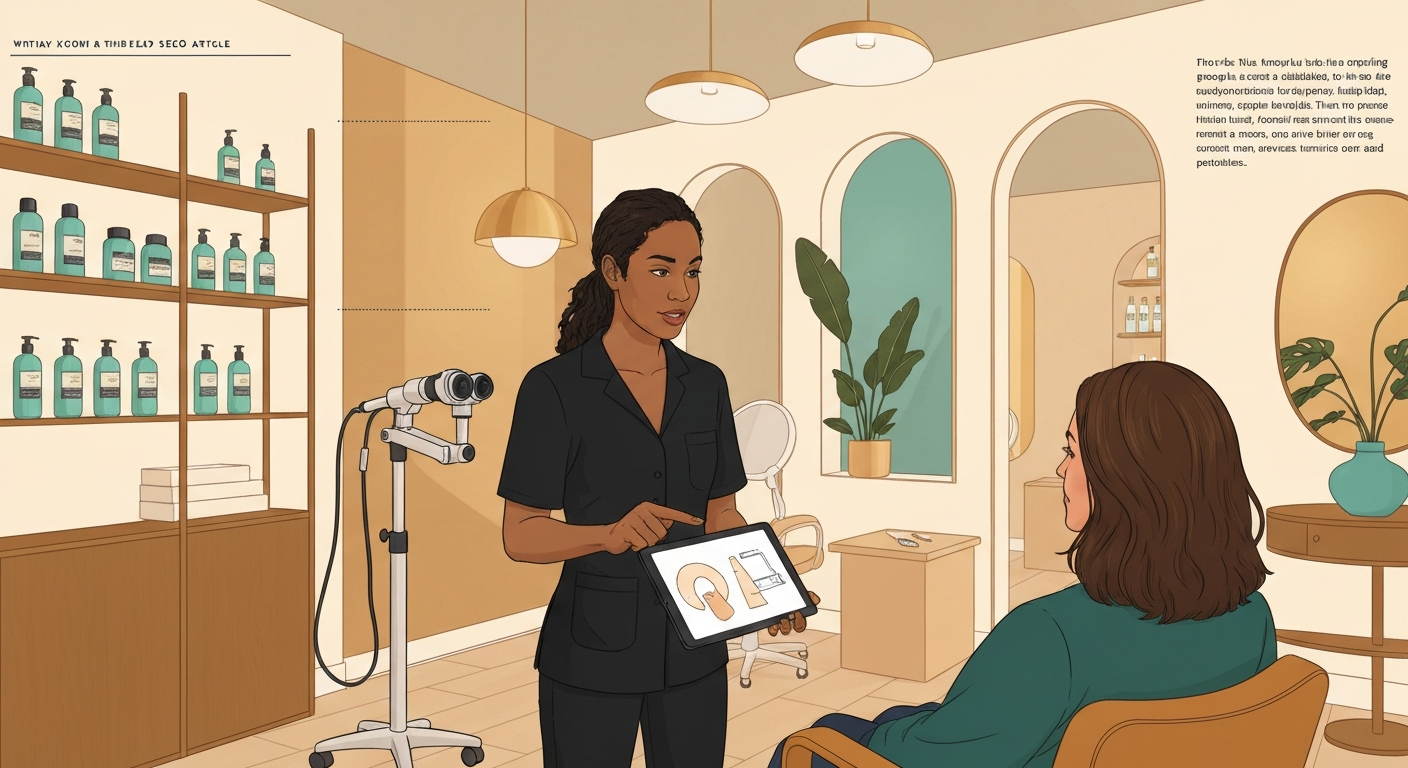
This is written for four types of people. First, salon owners who want to specialize in hair-growth services or simply grow their clientele faster. Second, independent stylists thinking about launching their own brand or moving into a suite model. Third, entrepreneurs building e-commerce businesses around hair-growth supplements, topicals, or tools. And fourth, founders developing private-label or white-label product lines. If you fall into any of those categories, you'll find something actionable here. Some sections overlap with tactics covered in guides about how to grow your salon business and how to grow salon clientele, so I'll keep the salon-specific content focused on what's unique to the hair-growth angle, the science positioning, the consultation model, and the product pairing strategy that sets this niche apart.
Define your niche before you do anything else
The biggest mistake I see in this space is trying to be everything to everyone. A hair business that says 'we do cuts, color, extensions, and hair loss treatments' confuses potential clients and dilutes your marketing. Before you spend a dollar on ads or a minute on content, you need to answer three questions: Who is your primary customer? What specific problem are you solving for them? And why should they believe you can solve it better than anyone else nearby or online?
Pinpoint your target customer
Hair-growth businesses tend to attract one of several distinct audiences. Women in their 30s to 50s experiencing postpartum or perimenopausal thinning. Men in their 20s to 40s with early androgenetic alopecia (AGA) who want options beyond a prescription. People with scalp conditions like seborrheic dermatitis that are affecting their hair density. And health-conscious consumers who want to take a proactive, nutrition-first approach before they notice significant loss. Each of these audiences has different pain points, different trust triggers, and different price sensitivity. Picking one as your primary focus sharpens everything from your service menu to your Instagram captions.
Build a clear value proposition
Your value proposition is the one-sentence reason a client should choose you. A strong one combines your audience, the outcome you deliver, and your credibility signal. For example: 'We help women in their 40s experiencing thinning hair through evidence-based scalp treatments and personalized nutrition guidance, no guesswork, no hype.' That kind of positioning does something generic salons cannot: it immediately pre-qualifies the right clients and filters out mismatched ones, which actually saves you time and improves conversion.
Choose your service and product mix
Once you know your audience, your service mix almost designs itself. A clinic-leaning model might anchor around scalp assessments, topical treatment protocols, and supplement consultations. A salon model might layer scalp-focused treatments onto existing cut-and-color services. An e-commerce model lives and dies by product credibility and content. Most successful hair-growth businesses I've seen eventually move toward a hybrid: some in-person services to build trust and gather testimonials, combined with a product line or subscription to generate recurring revenue.
Evidence-based content pillars and where the science actually stands
Here's where a lot of hair businesses get into trouble: they either overclaim (promising regrowth from a rosemary oil shampoo) or underclaim (avoiding all science talk because it feels complicated). The sweet spot is being genuinely honest about what evidence exists, what it shows, and where the gaps are. That honesty builds more trust than any marketing copy.
Nutrition and supplements
A 2023 JAMA Dermatology systematic review of 30 studies found that certain oral supplements, including Viviscal, Nutrafol, omega-3 and omega-6 combinations with antioxidants, tocotrienols, zinc, and pumpkin seed oil, showed potential to improve hair parameters. The honest caveat is that study quality and heterogeneity limit how broadly you can apply those findings. Biotin is probably the most over-hyped supplement in this category: multiple systematic reviews show limited high-quality evidence for benefit in people without a documented biotin deficiency. Iron is worth taking seriously for women, a systematic review and meta-analysis found an association between low ferritin and non-scarring alopecia, supporting iron testing and repletion where deficiency is confirmed. See Iron Deficiency and Nonscarring Alopecia in Women: Systematic Review and Meta‑Analysis (PMC) for the 2022 pooled analysis linking low ferritin to non‑scarring alopecia and noting that treatment effects varied across studies. Vitamin D is similar: evidence supports measuring it and correcting deficiency, but blanket claims about vitamin D causing hair regrowth go beyond what the data currently supports. When you build your content or product messaging, lead with 'support' and 'optimize' language rather than 'treat' or 'cure', not just because it's legally safer (more on that later), but because it's simply more accurate.
Topical treatments
Topical minoxidil is the most evidence-supported treatment you can recommend or carry. Randomized controlled trials show that 5% minoxidil is superior to 2% and placebo for increasing hair count in men, and the 2%-5% range has demonstrated benefit in women. It's guideline-recommended as a first-line therapy for AGA. Topical finasteride is newer but increasingly well-supported: Phase III trials show it produced greater hair-count improvements than placebo with lower systemic DHT exposure than oral finasteride. If you're advising clients on topicals or selling them, these two are the most defensible anchors in your lineup. Herbal topicals like rosemary oil have smaller, lower-quality trials showing some promise, but should be positioned as complementary, not primary.
Scalp care and the microbiome angle
Scalp health is one of the fastest-growing legitimate areas in hair science. Research is identifying associations between scalp microbiome dysbiosis (shifts in organisms like Malassezia, Cutibacterium, and Staphylococcus) and conditions like dandruff, seborrheic dermatitis, and some alopecia types. One longitudinal study found that topical coconut oil correlated with enrichment of certain commensal scalp microbes and improved scalp measures, results that are hypothesis-generating rather than clinical proof of regrowth, but still genuinely interesting. This is an area where you can lead with curiosity and education: 'here's what we know, here's what we're watching.' That kind of intellectual honesty positions your brand as credible rather than salesy.
Home remedies: what to say and what not to
Onion juice, aromatherapy blends, herbal rinses, these come up constantly in the hair-growth conversation and clients will ask you about them. Cochrane reviews and systematic reviews rate most home remedy evidence as small, older, and mixed in quality. There's one small RCT on onion juice for alopecia areata showing a positive signal, but it hasn't been replicated at scale. The right messaging here is something like: 'Some people find this helpful and the risk is low, but we don't have strong enough evidence to recommend it as a standalone treatment.' That's not a buzzkill, it's what makes clients trust your other recommendations.
Designing your product and service offerings
Now that you know what the science supports, you can build offers that are both credible and commercially viable. The goal is to create a product and service architecture where each tier solves a real problem and leads naturally to the next.
Formulation principles for topicals and supplements
If you're developing or sourcing topical products, the ingredients with the strongest evidence base are minoxidil, topical finasteride (for men, via licensed channels), caffeine, saw palmetto, and ketoconazole for scalp-condition management. For supplements, formulations that combine zinc, omega-3/6, antioxidants, and amino acid precursors like L-cysteine sit on the better-evidenced end of the spectrum. Work with a formulator or contract manufacturer who can provide a certificate of analysis, third-party testing, and ingredient-level sourcing transparency, these documents become marketing assets as much as compliance requirements.
Service protocols that deliver and document results
The single most valuable thing you can add to a hair-growth service is documentation. Before-and-after trichoscopy images (captured with a scalp camera or trichoscope) give clients something concrete to track and give you undeniable proof of concept. Build a protocol that includes an intake questionnaire (covering diet, medications, stress, hormonal history), a scalp analysis, a personalized recommendation, and a scheduled follow-up at 90 days, because that's roughly the minimum timeline to see meaningful changes in hair growth cycles. Frame the follow-up as part of the service, not an upsell.
Bundling for value and compliance
Bundles work well in this category because hair-growth results genuinely require a multi-angle approach. A 'Scalp Reset Bundle' might include a scalp treatment session, a 90-day supply of a microbiome-supporting scalp serum, and a follow-up consultation. A 'Foundation Bundle' for e-commerce customers might pair a supplement with a topical scalp tonic and a usage guide. Just be careful that your bundle descriptions don't aggregate claims in a way that crosses into drug territory, claiming a bundle will 'treat hair loss' is different from 'supporting healthy hair growth and scalp conditions.'
Service menus for salon, clinic, and hybrid models
How you structure your menu depends on your licensing, your space, and how clinically adjacent you want to position your business. Here are three practical frameworks.
| Model | Anchor Service | Add-On Services | Retail/Product Pairing | Avg. Client Value |
|---|---|---|---|---|
| Salon | Scalp treatment + hair analysis (60 min) | Scalp massage, growth-phase conditioning treatment | Shampoo, scalp serum, supplement starter kit | $120-$250/visit |
| Clinic/Trichology | Full trichoscopy consultation (90 min) | Low-level laser therapy, PRP referral, follow-up check-ins | Topical minoxidil, prescription-adjacent protocols | $300-$600/visit |
| Hybrid/E-commerce | Virtual consultation (45 min) | Custom supplement protocol, scalp coaching session | 90-day product subscription, digital education program | $150-$400/visit + $40-$80/month |
In-salon treatment flow
A well-designed in-salon growth treatment typically runs 60 to 90 minutes and includes a scalp consultation, a clarifying pre-treatment to remove buildup, the active treatment phase (which might involve a growth serum with massage, a low-level laser cap session, or a microneedling scalp treatment if you're licensed and equipped), and a finishing protocol with take-home instructions. Charging $150 to $250 for this is realistic in most mid-to-large markets, and pairing it with a product recommendation converts at a much higher rate than a generic product suggestion at checkout.
Consultations and follow-ups
Consultations are where you build the relationship that drives retention. A good intake process asks about diet quality, sleep, stress levels, recent hormonal changes (pregnancy, perimenopause, thyroid history), current medications (some of which cause hair shedding), and any prior diagnoses. You don't need to be a dermatologist to gather this information, but you do need to know when to refer out. Build a referral relationship with at least one local dermatologist or trichologist so you have a credible pathway for cases that need clinical intervention. Clients will respect you more for saying 'I think you should also see a specialist' than for overselling your services.
Product strategy: e-commerce, private label, and supplements
If you're building a product line, you have three main routes: sell established brands as an authorized retailer, white-label existing formulas under your brand, or develop a true private-label product with custom formulation. Each has trade-offs.
| Approach | Upfront Cost | Differentiation | Margin | Time to Launch |
|---|---|---|---|---|
| Authorized retailer | Low | None (shared brand) | 20-40% | 2-4 weeks |
| White label | Medium | Brand name only | 40-60% | 6-12 weeks |
| Private label (custom formula) | High ($10k-$50k+) | Full differentiation | 60-75% | 6-18 months |
For most early-stage hair businesses, white labeling is the practical starting point. You get branded products without the formulation risk, and you can validate demand before investing in a custom formula. When you're ready to develop your own, focus on one or two hero products with the strongest evidence base, a scalp serum and a supplement, rather than launching a 10-SKU range you can't support with content and inventory.
Supplement considerations and inventory
Supplements sold in the US are regulated under DSHEA as foods, not drugs. This means you can make structure/function claims (for example, 'supports healthy hair growth') but not disease claims ('treats hair loss'). Every structure/function claim must include the FDA disclaimer: 'This statement has not been evaluated by the Food and Drug Administration. This product is not intended to diagnose, treat, cure, or prevent any disease.' The FTC separately requires that health product advertising claims be backed by competent and reliable scientific evidence. This isn't just legal housekeeping, it's actually a positioning advantage if you lean into it. Being the brand that explains exactly what the evidence does and doesn't say is refreshing in a category full of over-promising.
Cosmetics vs. drugs: knowing where your products sit
This is the compliance trap that catches a lot of founders off guard. Under FDA rules, a product's classification depends primarily on its intended use as communicated in labeling and marketing, not just its ingredients. A shampoo that 'cleanses hair' is a cosmetic. The same shampoo marketed as something that 'treats hair loss' can be regulated as a drug. If you're selling in the EU, Regulation (EC) No 1223/2009 governs cosmetic products, and claims must comply with EU common criteria including being truthful, evidenced, honest, and fair. Build your labeling and ad copy with a legal or regulatory consultant before launch, not after.
Customer acquisition: channels, goals, and how to budget
Customer acquisition for a hair-growth business works best when your channels reinforce each other. Local SEO drives in-person discovery. Content builds search traffic and educates cold audiences. Social media maintains awareness and shows proof. Paid ads accelerate what's already working. Partnerships and referrals bring in pre-qualified warm leads. Here's how I'd think about allocating a modest early-stage budget.
| Channel | Primary Goal | Recommended Budget Share (early stage) | Time to Results |
|---|---|---|---|
| Local SEO / Google Business Profile | Organic discovery, map pack ranking | 10% (time investment heavy) | 3-6 months |
| Content / blog SEO | Long-term organic traffic, authority building | 15% (writing + tools) | 6-12 months |
| Social media (organic) | Trust, community, retention of existing followers | 10% (time cost) | Ongoing |
| Paid social (Meta/Instagram) | Audience building, product sales, retargeting | 30% | 2-6 weeks |
| Google Ads (search) | High-intent client capture | 20% | 2-4 weeks |
| Referral / partnership programs | Warm lead acquisition, LTV amplification | 15% | 1-3 months |
These allocations should shift as you learn what converts in your specific market. In most cases, Google Search and Local SEO produce the highest-quality leads because the prospect is already looking for what you offer. Paid social is better for product e-commerce and brand building than for high-ticket clinic services, where trust is the primary conversion barrier.
Local SEO and Google Business Profile: your most valuable free tool
If you have any kind of physical location, salon, clinic, suite, your Google Business Profile (GBP) is the single highest-leverage digital asset you have. Most people searching for hair-growth services in their city are going to click a map result before they ever visit your website. Here's how to make sure that map result is you.
Set up and optimize your GBP properly
- Claim and verify your listing at business.google.com if you haven't already.
- Choose the most specific primary category that fits your business (for example, 'Hair Salon,' 'Trichologist,' or 'Beauty Salon' depending on your model).
- Add all secondary categories that apply, such as 'Skin Care Clinic' if you offer scalp treatments with a clinical angle.
- Fill in every field: hours, phone, website, booking link, description (use your primary keyword and location naturally), and services with prices where possible.
- Upload at least 10 high-quality photos including your space, your team, before/after scalp results (with client consent), and any retail products you carry.
- Enable the booking feature and connect it to your scheduling software so potential clients can book directly from the map result.
Reviews: the most underdeveloped growth lever in most salons
Google review volume and recency are among the strongest signals in local ranking. Most salons collect reviews passively, which means slowly. Build an active review system: send a follow-up text or email within 24 hours of every appointment with a direct link to your review page. Train your team to mention it verbally in a natural way, something like 'If you're happy with today's results, it would mean a lot if you left us a quick Google review.' Aim for at least one new review per week. Respond to every review, positive or negative, within 48 hours. For negative reviews, acknowledge the concern publicly, offer to resolve it privately, and never argue in the thread.
Local citations and NAP consistency
Your NAP (name, address, phone number) should be identical across every directory where your business appears: your website, GBP, Yelp, Facebook, Healthgrades (if clinic-adjacent), and any local business directories. Inconsistencies confuse Google's local ranking algorithm and reduce your chances of appearing in the map pack. Use a tool like Moz Local or BrightLocal to audit and fix citations, it's a one-time cleanup that pays off for months.
Local content that reinforces your map ranking
Google's local algorithm weighs your website's relevance alongside your GBP signals. Publishing location-specific content (for example, 'best hair-growth treatments in [your city]' or 'scalp care tips for [your climate]') helps connect your website to your local presence. One well-optimized location page and two to three locally relevant blog posts per quarter can make a measurable difference in how often you appear in map pack results for searches like 'hair loss treatment near me' or 'scalp treatment [city name].'
Content marketing: topics that build authority and drive traffic
For a hair-growth business, content marketing does double duty: it brings in organic traffic from people searching for answers, and it does the trust-building work that converts cold visitors into paying clients. The key is building content around the same evidence-based pillars that power your services.
Sample content topics tied to hair-growth science
- What your ferritin level has to do with hair shedding (and what to do if it's low)
- Topical minoxidil: what the trials actually show, and who it's most likely to help
- The scalp microbiome explained: why some people get dandruff and others don't
- Biotin for hair growth: sorting the hype from the evidence
- Vitamin D and hair loss: when testing matters and when it doesn't
- Postpartum hair shedding: what's normal, what to watch, and what actually helps
- Seborrheic dermatitis and hair loss: the scalp condition most people don't know they have
- Pumpkin seed oil for hair: what one solid trial showed and what we still don't know
- How to read a supplement label and spot claims that go too far
- Scalp massage: what the research shows about tension and follicle stimulation
Notice that each of these topic ideas has built-in intellectual honesty, 'what one trial showed,' 'what the evidence actually says,' 'when it doesn't.' That framing isn't just ethically right; it's a genuine search differentiator in a category where most content swings between uninformed enthusiasm and dry clinical language. A brand that explains the nuance will earn more bookmarks, shares, and return visits.
Conversion: turning visitors and walk-ins into paying clients
Acquisition gets people to your door or landing page. Conversion is everything you do in that first interaction to make them buy or book. In a hair-growth context, conversion is heavily trust-dependent because clients are often dealing with something emotionally sensitive, their hair loss. A few high-leverage conversion principles follow.
Website and booking experience
Your website's conversion rate hinges on three things: clarity of offer, proof of results, and friction-free booking. Your homepage should communicate your niche and primary offer within five seconds. Social proof in the form of before-and-after photos (with consent), client testimonials, and specific outcome descriptions works far better than generic five-star statements. Make your booking button visible without scrolling on every page, and connect it to a scheduling tool that confirms the appointment instantly. Every hour of friction in the booking process costs you a percentage of conversions.
Product pages for e-commerce
For product-based businesses, your product page is your sales conversation. It needs to explain the mechanism of action in plain language (why does this ingredient do what you're saying it does?), reference the evidence tier honestly (clinical trial vs. pilot study vs. traditional use), include a clear usage protocol, and address common objections like 'how long until I see results?' and 'will this interact with anything I'm taking?' An honest, well-structured product page converts better than a page full of vague superlatives, and it dramatically reduces the volume of pre-purchase support questions.
Aftercare as a conversion tool
What you do in the 48 hours after a client's first appointment or first product purchase is underestimated. A simple follow-up message checking in on how their scalp feels, answering any questions, and reminding them of their next step (booking the 90-day follow-up, tracking their supplement use) has a measurable impact on retention. It signals that you're invested in their outcome, not just their payment. This is especially important in the hair-growth space, where results genuinely take time and clients can get discouraged.
Retention and monetization: keeping clients and growing revenue per client
In most service businesses, retention drives profitability far more than acquisition. In a hair-growth business, the retention mechanics are particularly well-suited to recurring revenue models because hair-growth protocols genuinely require months of consistent use.
Subscriptions and loyalty programs
A supplement or topical subscription is one of the cleanest recurring revenue models in this category. A 90-day auto-ship program at a 15-20% discount versus one-time purchase is compelling for clients who are committed to a protocol. In a salon context, a monthly membership that includes one scalp treatment, a supplement refill, and priority booking works well at $80 to $150 per month depending on your market. Loyalty programs that reward cumulative spend or referrals can layer on top of either model.
Upsells that make clinical sense
The best upsells in this business are ones that genuinely improve outcomes. Upgrading a client from a basic scalp treatment to one that includes trichoscopy documentation is a meaningful upsell, not just because it's more revenue, but because clients who see their own scalp images are far more motivated and compliant. Similarly, adding a supplement protocol to a topical treatment recommendation makes scientific sense because the two pathways (internal nutrition, external treatment) work on different mechanisms. When your upsells are grounded in logic, they feel like advice, not selling.
Staff training and service consistency
If you have a team, your retention rate will only be as consistent as your least-trained staff member. Build a training program that covers: the basic biology of the hair growth cycle and why it matters for setting client expectations; how to conduct and document a scalp consultation; the evidence base behind your product and service recommendations; and how to handle common questions and objections without overclaiming. A staff member who can explain why results take 90-plus days in plain language prevents a huge volume of client frustration and refund requests.
Your 90-day launch and growth plan
Ninety days is enough time to get a hair business from concept to early traction, or from existing business to a repositioned, better-performing version of itself. Here's a realistic sequencing.
| Phase | Weeks | Priority Actions | Success Marker |
|---|---|---|---|
| Foundation | 1-4 | Define niche and value prop; audit or build GBP; finalize service menu and pricing; set up booking system; photograph space and products; draft 4 core website pages (home, services, about, contact) | GBP verified and fully completed; website live with booking enabled |
| Acquisition | 5-8 | Launch Google Ads for 2-3 high-intent local keywords; publish 2 SEO blog posts; activate review request system; reach out to 3-5 potential referral partners (dermatologists, nutritionists, personal trainers); launch social proof campaign with client testimonials | First 20 new client bookings or 50 product sales; 10+ new Google reviews |
| Optimization | 9-12 | Analyze booking conversion data and identify drop-off points; launch a subscription or membership offer; introduce first upsell protocol; publish 2 more content pieces; run a referral incentive campaign; review KPIs and adjust ad spend | 10%+ repeat booking rate; subscription or membership MRR established; CPL declining week-over-week |
Operations, compliance, and the KPIs that actually matter
Operations and compliance aren't the exciting part of building a hair business, but they're the difference between one that scales and one that stalls or gets shut down. Here's what to focus on.
Legal and compliance checklist
- Confirm your product labels include required FDA disclaimers for any structure/function claims on supplements
- Review all advertising copy for FTC compliance — claims must be backed by competent and reliable scientific evidence
- Classify each product correctly as cosmetic or drug based on intended use language in labeling and ads
- If selling in the EU, confirm compliance with Regulation (EC) No 1223/2009 cosmetics regulation
- Obtain client consent for any before-and-after photography used in marketing
- Ensure any clinical services (microneedling, laser, PRP referrals) comply with your state/country licensing requirements
- Have a clear returns and refund policy for product sales that meets your platform's requirements
KPIs worth tracking from day one
| KPI | What It Tells You | Target (early stage) |
|---|---|---|
| Cost per lead (CPL) | Acquisition efficiency by channel | Under $30 for salon, under $20 for e-commerce |
| Booking conversion rate | Website/GBP to confirmed appointment | 15-25% |
| Client return rate (90-day) | Retention quality after first visit | 40%+ within 90 days |
| Average order/visit value | Upsell and bundling effectiveness | Increase 10-15% per quarter |
| Monthly recurring revenue (MRR) | Subscription and membership stability | Set target at 20% of total revenue by month 6 |
| Google review count and rating | Local trust signal strength | 4.7+ stars; 5+ new reviews per month |
| Organic search traffic (monthly) | Content strategy ROI | 10-20% month-over-month growth for first 6 months |
Partnerships that accelerate growth
Strategic partnerships are one of the most underused growth levers in the hair business. A relationship with a local dermatologist creates a two-way referral channel: you send clients with clinical presentations to them; they send patients wanting complementary scalp care to you. Nutritionists and functional medicine practitioners are natural partners if your positioning includes the diet and supplement angle. Fitness studios and wellness centers are worth approaching if your target client is health-conscious. The pitch for any partnership is simple: 'Our clients have the same problem your clients have, and we solve different parts of it.'
Building a brand that lasts in a crowded market
The hair-growth category is noisy. There are thousands of products making similar claims, and a growing number of salons and clinics trying to capture the same market. What separates businesses that build loyal audiences from ones that compete purely on price is intellectual credibility combined with genuine human warmth. Be the business that explains the science honestly, acknowledges that results take time, celebrates incremental progress with clients, and never oversells. In my experience, that combination is rare enough in this category to function as a genuine competitive advantage. Clients who trust you tell other people about you, and that word-of-mouth effect compounds faster than any ad spend.
FAQ
What is the first step to grow a hair‑focused business (salon, e‑commerce, clinic or hybrid)?
Define a clear niche and value proposition: pick a primary client segment (e.g., women with female pattern hair loss, postpartum hair thinning, men with early androgenetic alopecia, scalp‑healthy clients) and a focused promise (e.g., evidence‑aligned scalp therapy and subscription supplements; clinical hair‑loss management with topical Rx options; a salon specializing in densifying styling + scalp treatments). A tight niche guides product/service design, pricing, messaging and partnerships.
How do I design evidence‑based product and service offerings without making unsupported medical claims?
Base offerings on evidence‑backed pillars (nutrition & supplements where deficiency may matter; topical treatments with demonstrated efficacy like minoxidil; scalp care and microbiome‑informed cleansers; procedural therapies supported by guidance). Use cautious language: describe mechanisms (supports hair density, nourishes hair), cite general evidence where appropriate, and avoid claims that a product "treats," "cures" or guarantees regrowth. Include clear disclaimers and, for any medical treatments, require medical oversight or referral.
Which supplements and tests are reasonable to include in a hair‑growth product lineup or clinical protocol?
Offer supplements with some supporting trials (multinutrient formulas, omega‑3/6 antioxidant blends, specific ingredients like pumpkin seed oil) and recommend targeted labs (ferritin/iron studies, vitamin D, TSH/thyroid screen, where clinically indicated). Emphasize testing and repletion only when deficiency is documented (e.g., ferritin, vitamin D) and avoid blanket promises — align product labels and marketing with DSHEA and FTC rules.
How should salons combine in‑salon services with product sales and subscriptions?
Create layered offers: an initial diagnostic/consultation (scalp assessment, photos), an in‑salon starter plan (4–8 weekly scalp treatments), and a subscription for at‑home maintenance products (topical serum, cleanser, and evidence‑aligned supplement). Bundle pricing for retention, offer tiered memberships (basic maintenance, clinical track with specialist consults), and include digital reminders, refill auto‑ship, and loyalty credit toward in‑salon upgrades.
What are high‑impact customer acquisition channels for a hair business and how should I prioritize them?
Prioritize channels by cost, intent and locality: 1) Local SEO & Google Business Profile to capture nearby searchers, 2) content marketing (blogs, science‑backed guides, FAQs) for organic traffic and trust, 3) social media (Reels, before/after, consult clips) to build awareness, 4) paid ads for targeted lead capture (search & social), and 5) partnerships/referrals (dermatologists, trichologists, influencers, local businesses). Early stage: invest in local SEO + 6–8 cornerstone content pieces; add paid ads and partnerships in month 2–3.
What does an actionable 90‑day launch/growth plan look like?
90‑day roadmap (high level): Days 1–30: finalize niche, value prop, product/service catalog, compliance checklist, basic pricing, set up website/GMB, create 6 content pillars and 8 cornerstone posts, configure booking & e‑commerce. Days 31–60: launch local SEO, run small paid search/social tests, start email welcome sequence, launch initial subscription offering, train staff on consultations and upsells, collect baseline KPIs (traffic, bookings, AOV). Days 61–90: scale best‑performing ads, implement referral program, publish case studies/testimonials, A/B test product pages and booking flows, review KPIs and set Q2 growth targets.
Next Articles

How to Grow Your Salon Business: Step-by-Step Growth Plan
Step-by-step plan to grow your salon business with hair-thinning positioning, lead funnels, packages, rebooking, and ret
Tips on How to Grow Your Hair Out: A Step by Step Guide
Step-by-step tips to grow hair out: stop breakage, build scalp routine, nutrition, safe actives, and track progress.

Grow Hair Long Tips: Step-by-Step Routine to Reach Length
Step-by-step grow hair long tips: boost scalp health, cut breakage, improve diet, and track progress for length.